
How is Free Energy Born?
Did you know that since the creation of the first solar panel, its efficiency has increased almost 25 times? Learn how science transforms sunbeams into savings for your business.
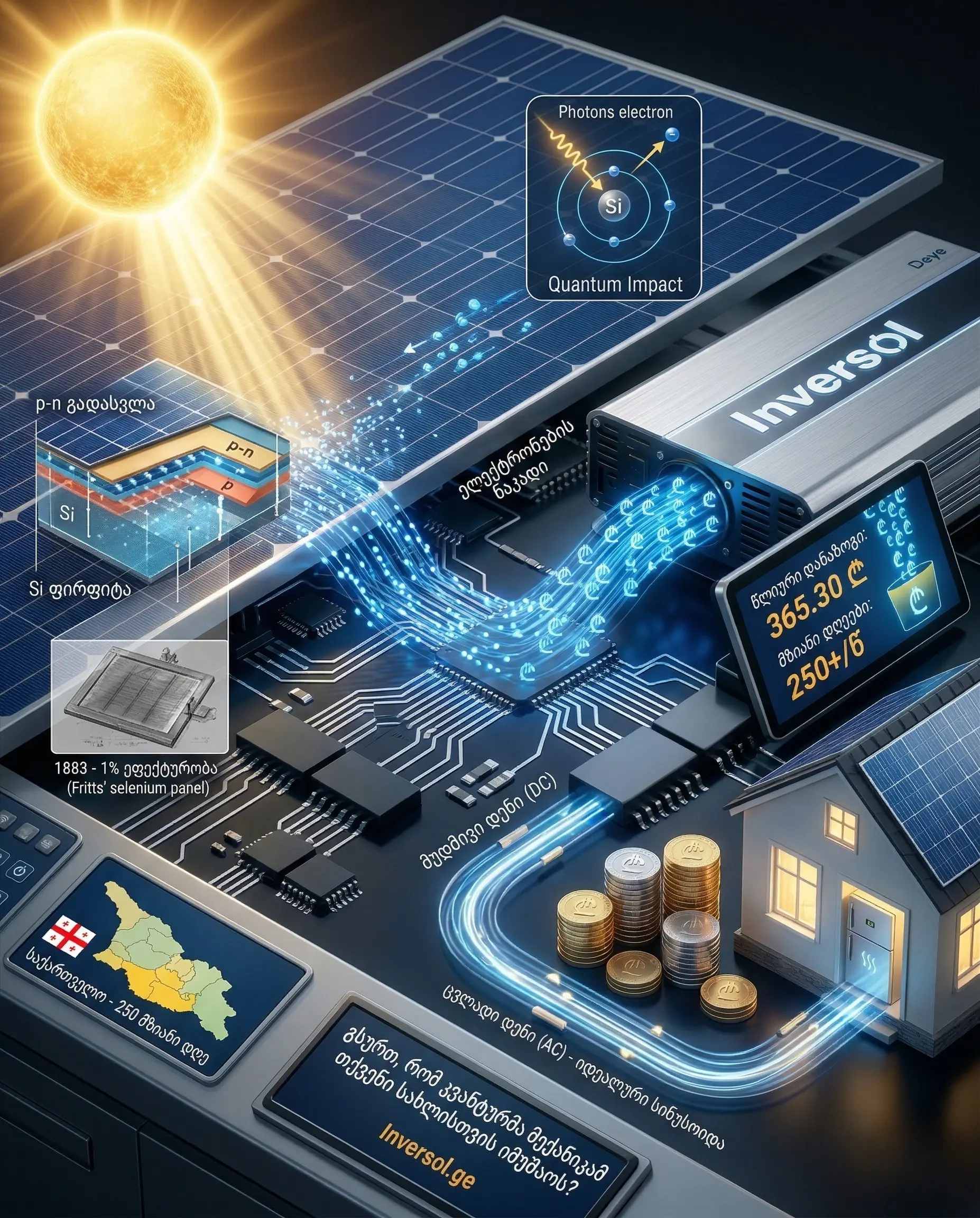
In 1883, inventor Charles Fritts coated the semiconductor selenium with a thin layer of gold. The efficiency of this first module was only 1%. Today, modern commercial silicon panels consistently deliver 22–25%, and laboratories are already approaching the 47% mark!
How does it actually work?
No magic, just solid-state physics:
-
1p-n junction
The foundation of a modern panel is a silicon wafer consisting of two layers. One artificially has an excess of electrons (n-type), and the other has a shortage of them ("holes", p-type). A permanent electric field emerges at the boundary of these layers.
-
2Quantum strike
A photon of light traveling from the Sun crashes into a silicon atom, transfers its energy, and knocks an electron out of its orbit.
-
3Current generation
The electric field of the p-n junction prevents the knocked-out electron from returning. It is forced to move along an external circuit — this is how a directed flow of charges is born, meaning Direct Current (DC).
From physics to everyday life
The problem is that your TV or industrial machine doesn't run on direct current. This is where the inverter joins the chain. Using a complex system of transistors, smart hybrid inverters (like Deye) convert DC into a perfect alternating current (AC) sine wave tens of thousands of times per second.
In Georgia, with its abundance of sun (about 250 clear days a year), this physics works flawlessly. A correctly calculated combination of panels, an inverter, and batteries guarantees that your home will always have comfort, light, and continuously running equipment — even if the city grid is resting.
Want to take a quantum leap towards energy independence?
Our engineers will select exactly the right equipment to make your business or home independent and comfortable.