



GENEX 2027
Hourly balancing — plan CAPEX now.
Install Inversol app
Quick access from your home screen
Open in Safari to install
To add Inversol to your home screen, open this page in Safari — tap ⋯ or the browser icon and choose "Open in Safari".
The Net-Billing tariff spread: wholesale export price vs full commercial import — and what Georgian businesses should do about it.
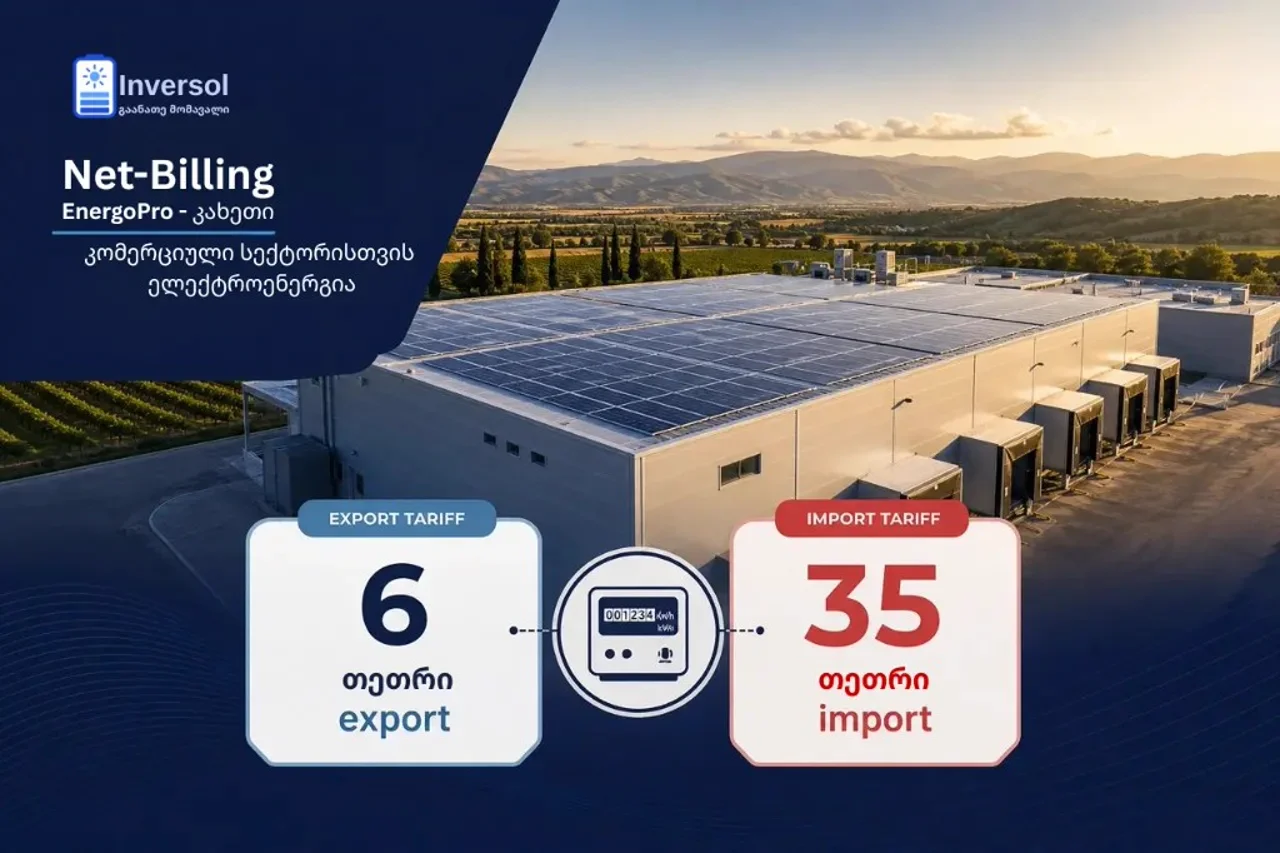
For Georgia's commercial sector, electricity is a major OPEX line. Microgeneration (up to 500 kW) promised lower bills — but rules changed. Net-Billing replaced the old Net-Metering model for many new connections. Businesses that install plain on-grid systems without energy banks risk surprise bills from Energo-Pro or Telasi.
Important: in Tbilisi (Telasi network), some sites can still apply for Net-Metering while quotas last. In regional Energo-Pro areas — including Kakheti — net-metering quotas are exhausted; new systems run on Net-Billing. See Legally Stop Your Electricity Meter for the legacy scheme.
Giorgi runs a cold-storage terminal in Kakheti on the Energo-Pro network. He expected net-metering like Tbilisi businesses, but the region is on Net-Billing only. His 100 kW array peaks at lunch when forklifts are idle — surplus flows to the grid at wholesale price.
"I'll export 5,000 kWh at lunch and pull the same 5,000 kWh back at night when compressors run. Net zero."
End of month: energy balance is zero — but amount due: 1,450 GEL. Net-Billing tariff scissors: the grid is no longer a free virtual energy bank.
Under Net-Billing, settlement is in GEL and tetri, not physical kWh. The gap between export credit and import cost is large.
| Component | Export (Net-Billing) | Import from grid (B2B) |
|---|---|---|
| Base energy cost | ~6–10 tetri | ~6–10 tetri |
| Transmission (GSE) | — | included |
| Distribution (Telasi / Energo-Pro) | — | included |
| ESCO, dispatch, taxes | — | included |
| Total | ~6–10 tetri/kWh | ~35 tetri/kWh |
Utilities credit the average weighted price of purchased electricity — wholesale cost from generation (Inguri HPP, thermal plants, etc.). Historically 6–10 tetri/kWh by season. Below we use 6 tetri as a conservative worst-case for the owner.
After sunset you buy at the full B2B tariff (380–220 V) — about 35 tetri/kWh (see GNERC 2026 tariff analysis and our system constructor at 0.35 GEL/kWh B2B).
Net-Metering offset kWh in kind — the grid as free storage. Net-Billing pays export at wholesale energy only and charges import at full delivered tariff. ROI shifts: on-grid without storage slows; hybrid + LiFePO4 improves payback.
Don't sell midday kWh cheap and buy them back expensive — store surplus in LiFePO4 and use it when the tariff is highest.
Solar feeds loads directly — no 35-tetri grid purchases at peak.
Surplus charges LiFePO4 instead of exporting at wholesale.
Use stored solar instead of grid at 35 tetri.
On-grid shuts down in outages. Inversol hybrid switches to energy bank in under 10 ms.
Model payback in the Inversol system constructor or request a load audit via contact.
When daytime export is cheap but evening peaks hurt, pair Net-Billing with storage and peak shaving for B2B — for example a HECKMAN 15 kWh module or other options in the energy bank catalogue.
Disclaimer: GNERC tariffs and methodology change. Figures are indicative for July 2026. Confirm current resolutions and your distributor's terms (Telasi, Energo-Pro).
Toward 2027, size storage for hourly prices — see GENEX 2027 for business. The EMS cloud that plans charge/discharge: PowerWallet Energy Manager. Full stack: INVERSOL FLEX · cloud & GENEX.
Inversol engineers will audit hourly load, size hybrid + LiFePO4, and model payback.
Hourly balancing — plan CAPEX now.

Self-consumption + evening buffer.

AI charge/discharge toward GENEX.
In-stock models from the Inversol warehouse — supply and install with Inversol and partners.