How to Choose a Hybrid Inverter in Georgia
How to size a hybrid inverter for home or business in Georgia: kW, 10 ms UPS, LiFePO4. Compare Deye — request a consult!
Install Inversol app
Quick access from your home screen
Open in Safari to install
To add Inversol to your home screen, open this page in Safari — tap ⋯ or the browser icon and choose "Open in Safari".
The factory warranty covers factory defects, not installation errors. These are the five installation mistakes that most often end in a voided warranty, how the manufacturer reacts, and a checklist to run before the system is switched on.
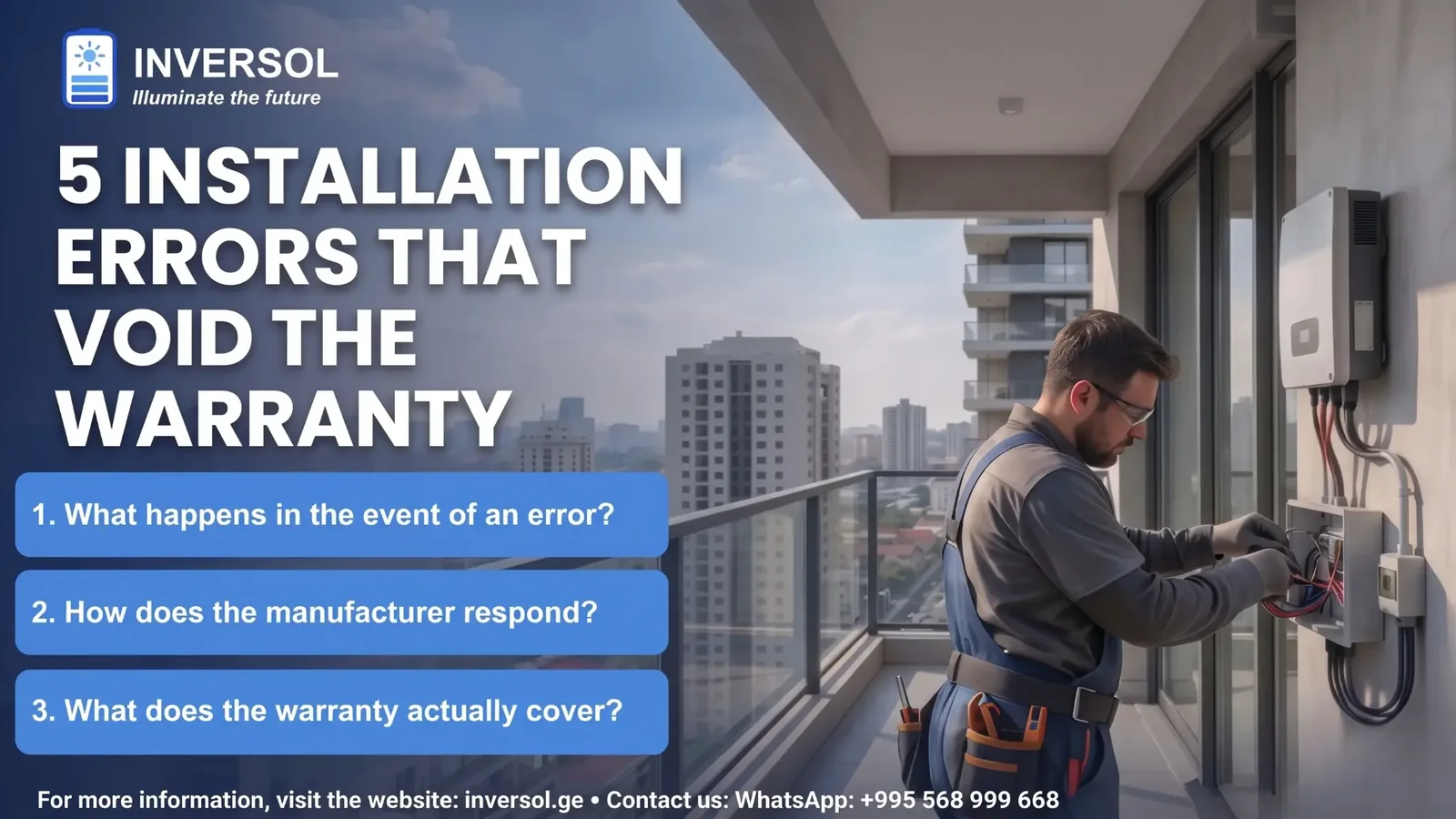
Most owners of solar systems assume that the factory warranty will automatically protect them if the equipment is damaged. In practice, the great majority of non-warranty cases are caused not by factory defects but by installation errors. Most manufacturers of inverters and panels cover factory defects only. If the equipment was damaged because installation rules were broken, the expert examination establishes this easily and warranty service is cancelled.
The safety of a solar plant starts with correctly sized cables. The direct-current (DC) side, especially from the batteries to the inverter, carries high currents.
What happens: the installer saves money and uses a thinner cable than the peak load requires. Because of its resistance the cable turns into a heater: it gradually overheats, its insulation melts and a short circuit begins.
How the manufacturer reacts: an overheated cable melts the inverter's connection terminals directly. When the inverter reaches the service centre and the technician sees melted, deformed or blackened contacts, that is clear evidence of a gross installation violation. The factory warranty is then voided immediately.
MC4 is the standard connector that joins solar panels to each other, but its incorrect use creates a risk of overheating and fire.
What happens: installers often mix cheap connectors of different brands, or crimp the cable with ordinary pliers instead of a dedicated crimping tool. Different metal alloys expand differently as the temperature changes. Microscopic gaps appear where a DC electric arc forms: a spark whose temperature reaches thousands of degrees.
How the manufacturer reacts: the arc melts both the connector itself and the inputs of the inverter's MPPT module. Melted DC ports point directly to poor-quality wiring, and the factory declines responsibility.
In a solar system the direct-current (DC) and alternating-current (AC) circuits must be strictly separated by the appropriate breakers, and the whole system must be properly grounded. Grounding is not a formality: it is the backbone of the system's safety.
What happens: the most common mistake is fitting ordinary AC breakers in the DC circuit. An AC breaker physically cannot extinguish a DC arc: it simply burns out. In addition, a surge protective device (SPD) is often not installed at all, and grounding is missing or only nominal (high resistance). An SPD works on a simple principle: it must divert excess voltage into the ground, so without grounding it is useless.
How the manufacturer reacts: if the grid voltage surges, or lightning strikes near the site, then without an SPD or grounding that high voltage hits the inverter's main board directly. When internal circuits and varistors "blow up", the service centre concludes that the system was damaged by voltage from outside and not by a factory defect. Without grounding, static charge builds up on the inverter case and internal boards. When examining an inverter burned by an electric shock, if no proper grounding loop is found at the site, the manufacturer fully disclaims responsibility.
The inverter is the "brain" of the system and must be told exactly what type of batteries and grid it works with.
What happens: the parameters are set incorrectly when the installation is finished. For example: the battery depth of discharge (DOD) is set lower than allowed, the charging current is set too high, or a lead-acid charging algorithm is selected for a lithium battery. Another mistake is an unauthorised firmware update of the inverter.
How the manufacturer reacts: modern inverters keep detailed logs in internal memory or on a cloud server. If it turns out that the device ran with wrong parameters, or the software was changed without official approval, the warranty terms are broken.
Making the physical connections correctly is the main condition for the system to survive.
What happens: reversed polarity (the + and - wires connected the wrong way round) is common. Another critical mistake is connecting more panels to one string than the inverter's MPPT input can accept.
How the manufacturer reacts: if excess voltage is applied or the polarity is reversed, the capacitors inside the inverter burst at once. This damage is so characteristic that the examination voids the warranty immediately.
Before the main switch of the inverter is moved to ON, a strict electrical and visual inspection is mandatory.
These checks must be done by a qualified electrician or installer. Solar panels produce dangerous DC voltage whenever they are lit.
Warranty service covers factory defects only. It does not protect the equipment from external physical impact, natural disasters or human error. Factory defects include an unexplained shutdown of internal electronics, premature degradation of solar panels and software faults.
Every warranty case starts with an examination of installation quality. For the exact warranty periods and conditions for a specific product, contact us on WhatsApp.
Want to check that your system was installed correctly and that your warranty is safe? Contact our partner installers. You can also read about how hybrid inverters work in our guide to choosing a hybrid inverter and visit our Academy for more information.
Write to us on WhatsApp: +995 568 999 668. Our partner installers will help.
How to size a hybrid inverter for home or business in Georgia: kW, 10 ms UPS, LiFePO4. Compare Deye — request a consult!
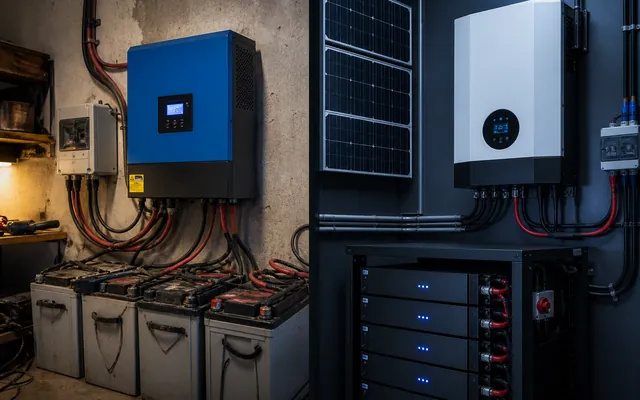
HF off-grid vs HV hybrid: topology, 20–50 ms transfer, AGM vs LiFePO4, anti-islanding and GNERC rules. Why cheap kits fail TCO in Georgia.
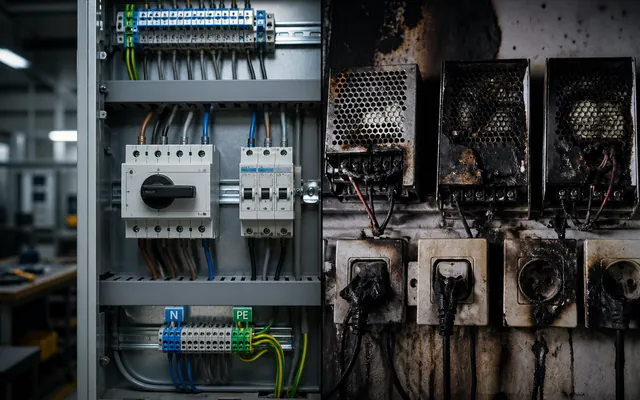
Why breaking N on Deye/EcoBSS burns loads at ~340–390 V, voids warranty, and who pays. Inversol N/PE rules and 3P+N Early-make / Late-break bypass.
In-stock models from the Inversol warehouse — supply and install with Inversol and partners.