How Long Will a Battery Last During a Power Outage?
Formula and a ready table for 5, 10 and 15 kWh.
Install Inversol app
Quick access from your home screen
Open in Safari to install
To add Inversol to your home screen, open this page in Safari — tap ⋯ or the browser icon and choose "Open in Safari".
A simple A + B + C formula: inverter power, battery capacity and charging speed — with worked examples for a Georgian home.
Imagine an ordinary family evening: the children are doing their homework, dad has important contracts to prepare, mum is watching her favourite series, and a tasty cake is baking in the oven. Everything is calm — and suddenly the lights go out: another unexpected fault on the grid. The neighbouring windows are dark too.
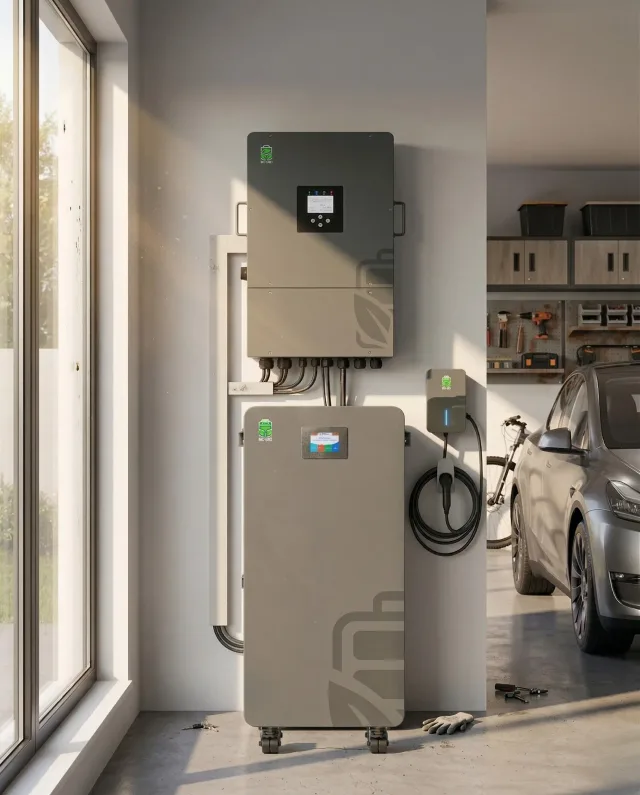
You sit calmly by the window. It is dark outside, and light comes only from your home. The TV is still on, the laptop is running, the fridge and the heating boiler keep working as usual — an outage does not stop life in your house, because you have a correctly sized backup energy system.
How do you get this result? Let us use a simple formula:
Here X is the energy independence and peace of mind of your home. To reach it, three parameters matter: inverter power (A), energy storage capacity (B) and charging power (C).
The inverter is the brain of the system. It converts the battery’s direct current (DC) into the alternating current (AC) used by household appliances. Its power determines not how long you will have electricity, but which appliances you can run at the same time.
Let us add up a typical base load of a home:
The total base load is 700 W (0.7 kW).
But life is not only base load. During an outage you may need an electric kettle (1.8–2.0 kW), a washing machine (2.0 kW) or, in summer, an air conditioner (1.2 kW). Let us look at two scenarios.
Base load plus a kettle (or a washing machine) and an air conditioner:
0.7 kW + 2.0 kW + 1.2 kW = 3.9 kW
For the start-up pulses of motors and compressors we add a 25–30% reserve:
3.9 kW × 1.25 ≈ 4.9 kW (about 5 kW)
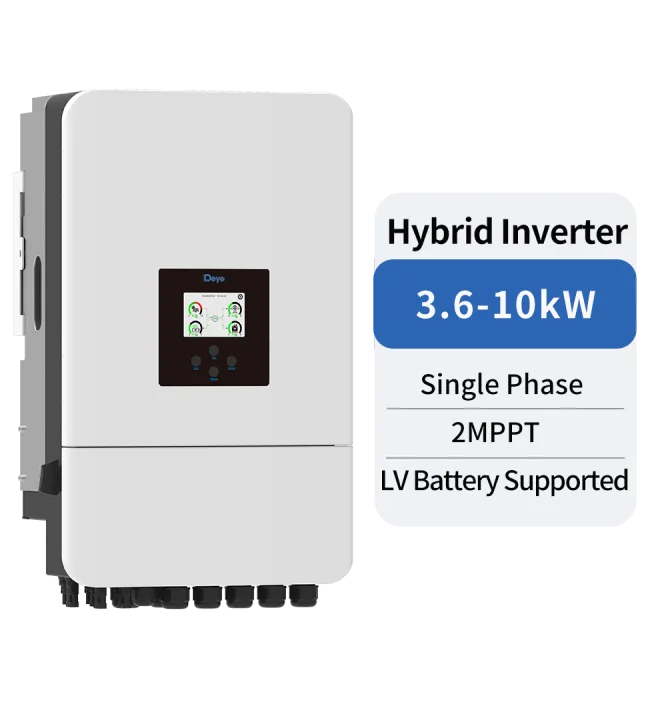
A 5 kW hybrid inverter handles this well: Deye SUN-5K-SG05LP1-EU-AM2-P.
Remember the cake from the start of our story. An electric oven draws about 2.0 kW on average. If we include it:
3.9 kW + 2.0 kW = 5.9 kW
With a 25% reserve:
5.9 kW × 1.25 ≈ 7.4 kW
Here the optimal choice is the 8 kW model — Deye SUN-8K-SG05LP1-EU-AM2-P.
In off-grid mode these inverters can deliver up to 2× their rated power for 10 seconds, which helps when compressors start — but you should not rely on that reserve continuously. A correctly chosen rating of 5 or 8 kW will, as a rule, let the system carry typical household peaks during an outage without overload.
| Parameter | Option 1 (no oven) | Option 2 (with oven) |
|---|---|---|
| Peak load | 3.9 kW | 5.9 kW |
| Power with a 25% reserve | 4.9 kW | 7.4 kW |
| Suitable inverter | Deye 5 kW | Deye 8 kW |
If the inverter is the brain, the battery is the energy store. Its main parameter is capacity, measured in kilowatt-hours (kWh). To find the capacity you need, multiply the average hourly consumption by the number of hours of autonomy you want.
During an outage only the essential equipment keeps running:
That is 550 W (0.55 kW) in total. Laptops are not included in this constant load: they have their own batteries and do not depend on the grid all the time.
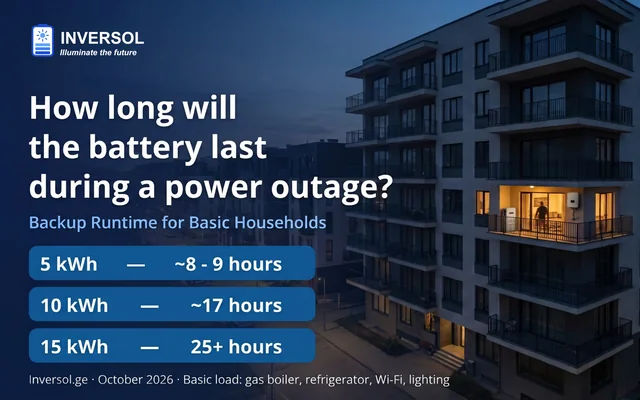
If we want the system to run for 8.5 hours:
0.55 kW × 8.5 h = 4.675 kWh (about 4.7 kWh)
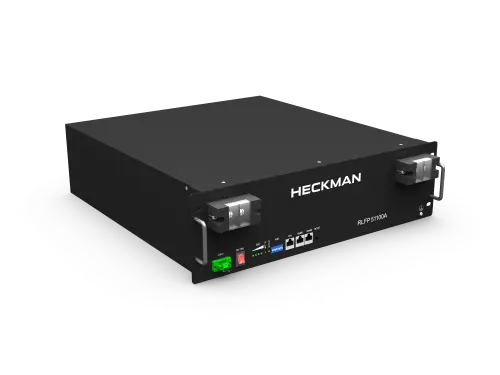
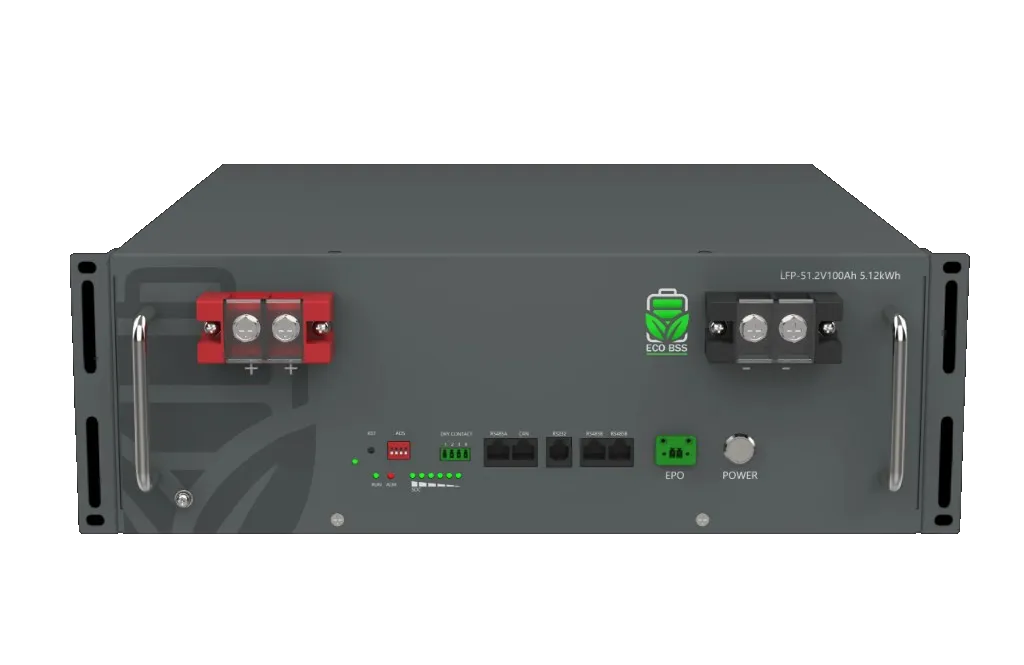
It is important to take the real usable energy into account. The Heckman and Ecobss LiFePO4 (lithium iron phosphate) batteries offered by Inversol give about 95% of their nominal capacity as usable energy — for a 5.12 kWh module that is 4.86 kWh. In addition, about 5% is lost in the inverter during conversion:
4.86 kWh × 0.95 = 4.62 kWh
So one 5.12 kWh module powers a 0.55 kW essential load for about 8 hours (4.62 kWh ÷ 0.55 kW ≈ 8.4 h). For 8.5–9 hours of autonomy, bigger loads or simply more peace of mind, it is better to install two modules (about 10 kWh in total).
If you prefer a more cautious estimate with a 90% depth of discharge (as in our article How Long Will a Battery Last During a Power Outage?), the result is still about 8 hours: 5.12 × 0.9 × 0.95 ÷ 0.55 ≈ 8.0 h.
This is the component people forget most often. First, a clarification: in our formula (A + B + C) the letter C stands for Charging. It is not the same as the technical C-rate (for example 0.3C or 0.5C), which describes the charge or discharge current relative to the battery capacity.
Why is charging speed so important? Imagine the grid comes back for only 2 hours during an outage and then drops again. If the system charges slowly, the battery will not manage to fill up and will meet the next outage half empty.
A concrete example: for a Heckman 5.12 kWh module the recommended charging current is 30 A (0.3C). That is about 1.5 kW, and a full charge takes about 3–3.5 hours. The maximum allowed current of the same module is 100 A (1C). Faster charging — for example at 0.5C, about 2.5 kW, a full charge in about 2 hours — is possible if the battery’s management system (BMS) allows it.
A correctly configured hybrid inverter and LiFePO4 battery let you refill the energy reserve even during short returns of the grid.
Besides backup power, modern hybrid systems have two very practical functions.
A home often has a limited power allowance from the grid — say 5 kW. When the kettle, the oven and the air conditioner switch on together, consumption rises to 8 kW and the main circuit breaker trips.
Peak shaving solves this problem simply: in the inverter settings you set a limit for consumption from the grid in advance — say 5 kW. When the house demands 8 kW, the inverter takes 5 kW from the grid and adds the missing 3 kW from the battery. As a result the grid breaker no longer trips. As soon as the load drops, the battery recharges from the grid again.
When the grid fails, a hybrid inverter switches from the grid to battery power within a few milliseconds. This means most equipment keeps running without a break. Keep in mind, however, that starting powerful compressors may require a larger power reserve. A quality inverter also helps protect household appliances from risks such as short circuits and grid overvoltage.
For the system to match your family’s needs exactly, it helps to know your base and monthly consumption (kWh). You can easily find it on your electricity bill or by asking the operator of the distribution company.
For a preliminary calculation you can use our online constructor or send us your consumption data via the contact page. The Inversol team will help you choose the optimal hybrid inverter and energy storage configuration.
See also: solar panel calculator by electricity bill, EV charger in Tbilisi: Type 2, phases, wallbox, what runs on a 5 kW, 12 kW and 20 kW inverter, single-phase or three-phase hybrid inverter.
Open the online constructor, select your appliances and get an exact calculation, or write to us on WhatsApp: +995 568 999 668. The Inversol team will help you choose.
Formula and a ready table for 5, 10 and 15 kWh.
kW, 10 ms UPS, LiFePO4 and Deye models.
Hybrid inverter + LiFePO4 without solar panels.
In-stock models from the Inversol warehouse — supply and install with Inversol and partners.